
Pulsed field ablation adverse events: what 6,930 FDA reports show across four catheters
The early reporting record
Medtronic's PulseSelect system received FDA clearance on December 13, 2023. Boston Scientific's Farapulse followed on January 30, 2024, Medtronic's Affera Sphere-9 on October 24, 2024, and Biosense Webster's Varipulse on November 6, 2024. By April 30, 2026, the four systems had generated 6,930 reports in the FDA's MAUDE database, and 99.8 percent of them could be tied to a named system. Of those reports, 173 (2.5 percent) were death-coded, 2,924 (42.3 percent) were injuries, and 3,815 (55.2 percent) were malfunctions.
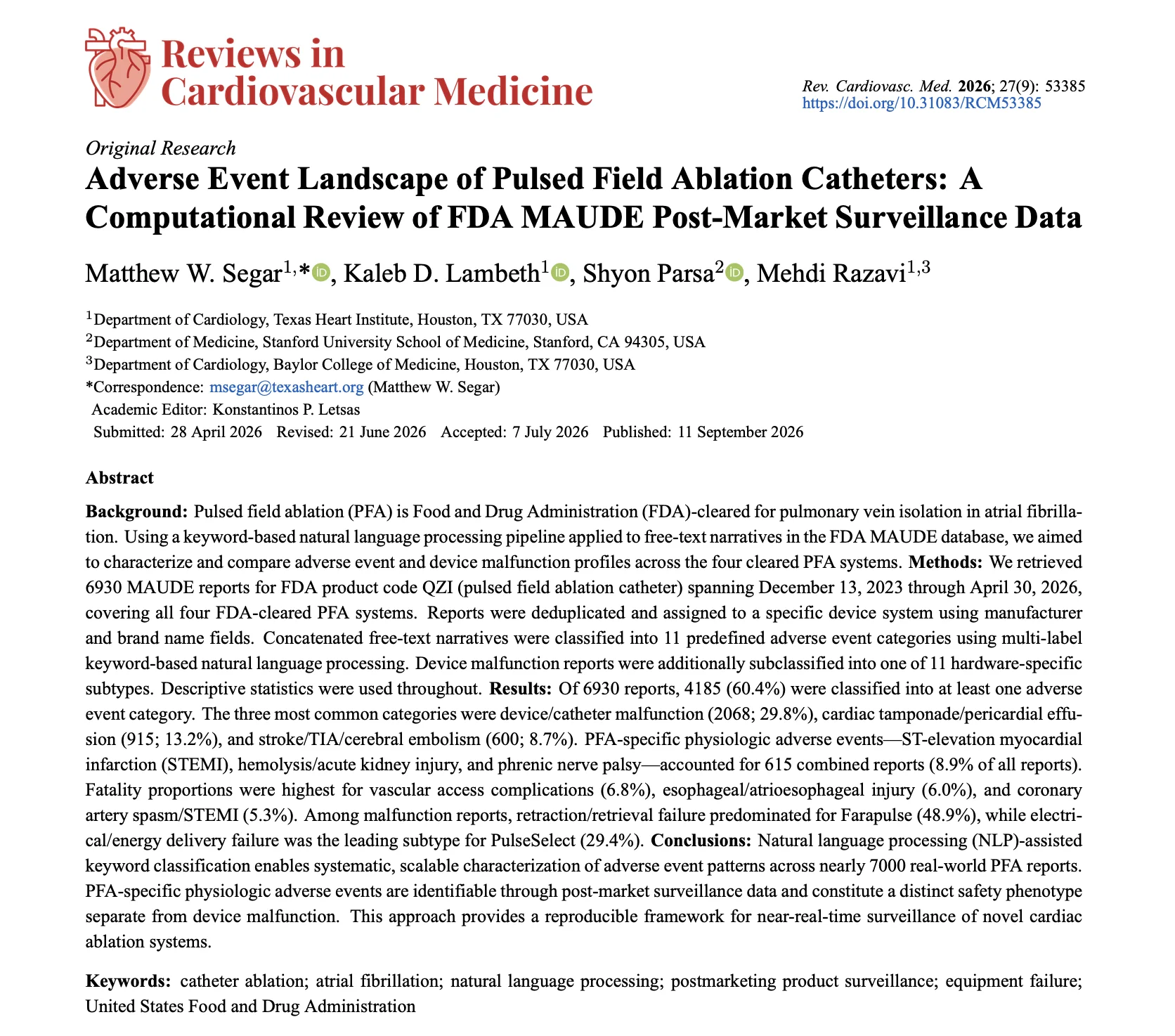
Researchers from the Texas Heart Institute analyzed that record and published the results in Reviews in Cardiovascular Medicine in 2026. This post walks through the findings that matter most to electrophysiologists, device safety teams and anyone reading a pulsed field ablation (PFA) safety communication. The full paper is on the journal site (DOI), and it sits alongside our other research and quarterly reports on the Claripulse resources page.
Why we read the free text
Pulsed field ablation destroys tissue with short electrical pulses that open pores in cell membranes, rather than with heat or cold. The paper's premise is that a mechanism this different should leave a different adverse event footprint, and that the footprint is visible in the free text of the reports.
MAUDE's structured fields record an event type and a few outcome flags. The clinical detail sits in the narrative: which part of the catheter failed, what the operator saw on the screen, which complication followed. At 6,930 reports, reading every narrative by hand stops being practical, so we classified each one into 11 adverse event categories defined in advance from the PFA literature. A report can match more than one category.
Adverse event categories
Of the 6,930 reports, 4,185 (60.4 percent) matched at least one category, at a mean of 1.26 categories per classified report. The remaining 2,745 matched none. The categories are ranked below by share of all reports.
Device malfunction leads at 2,068 reports (29.8 percent), which is what an early-adoption record usually looks like: new hardware, new operators, a steep learning curve. Cardiac tamponade or pericardial effusion follows at 915 (13.2 percent), and stroke, TIA or cerebral embolism at 600 (8.7 percent).
The ranking by volume differs from the ranking by severity. Stroke or TIA carries the highest life-threatening share at 16.8 percent. The highest death-coded shares belong to small categories:
| Category | Reports | Death-coded | Life-threatening |
|---|---|---|---|
| Vascular access complications | 103 | 6.8% | 6.8% |
| Esophageal / atrioesophageal injury | 215 | 6.0% | 10.2% |
| Coronary artery spasm / STEMI | 319 | 5.3% | 6.3% |
| Cardiac tamponade / pericardial effusion | 915 | 4.9% | 7.1% |
| Heart block / conduction disturbance | 408 | 4.4% | 9.6% |
| Atrial flutter / arrhythmia recurrence | 326 | 4.3% | 5.5% |
| Hemolysis / acute kidney injury | 166 | 4.2% | 7.8% |
| Stroke / TIA / cerebral embolism | 600 | 3.0% | 16.8% |
| Phrenic nerve palsy | 130 | 0.8% | 0.8% |
| Device / catheter malfunction | 2,068 | 0.5% | 1.5% |
| Pulmonary vein stenosis | 28 | 0.0% | 3.6% |
Esophageal injury deserves a second look. It appears 215 times in this record, with the second-highest death-coded share. The data cannot say whether that rate is lower than with thermal ablation, because the reports carry no denominator and no comparison group.
Complications specific to electroporation
Three categories arise from the physics of the energy source, not from catheter handling or transseptal technique: coronary artery spasm, hemolysis with acute kidney injury, and phrenic nerve palsy. Together they account for 615 reports, or 8.9 percent of the total.
| Category | Reports | Share of all reports |
|---|---|---|
| Coronary artery spasm / STEMI | 319 | 4.6% |
| Hemolysis / acute kidney injury | 166 | 2.4% |
| Phrenic nerve palsy | 130 | 1.9% |
Coronary spasm is the most frequent of the three and carries a 5.3 percent death-coded share. The paper draws procedural implications from each. For coronary spasm, intracoronary or intravenous nitroglycerin should be available during isthmus ablation. For hemolysis and kidney injury, it recommends awareness of application counts and post-procedural hydration protocols. Phrenic nerve palsy is the mildest of the three in this record, with 0.8 percent death-coded and 0.8 percent life-threatening.
Each catheter fails differently
The four systems differ in architecture, and the failure modes follow the hardware. The table summarizes the record for each.
| System | Maker | Cleared | Reports | Death-coded | Malfunction | Tamponade |
|---|---|---|---|---|---|---|
| Farapulse | Boston Scientific | Jan 30, 2024 | 4,373 | 140 (3.2%) | 2,440 (55.8%) | 684 (15.6%) |
| PulseSelect | Medtronic | Dec 13, 2023 | 1,569 | 15 (1.0%) | 1,097 (69.9%) | 108 (6.9%) |
| Sphere-9 / Affera | Medtronic | Oct 24, 2024 | 570 | 14 (2.5%) | 168 (29.5%) | 47 (8.2%) |
| Varipulse | Biosense Webster | Nov 6, 2024 | 403 | 4 (1.0%) | 110 (27.3%) | 72 (17.9%) |
We also sorted the malfunction reports into 11 hardware subtypes. Across all four systems, retraction and retrieval failure was the largest subtype, at 802 reports (38.8 percent of classified malfunctions). The concentration is in Farapulse, where it accounts for 48.9 percent of malfunction reports. Farapulse uses a collapsible pentaspline basket, and the paper ties that architecture to its leading failure mode. PulseSelect shows a different leader: electrical or energy delivery failure at 29.4 percent of its malfunction reports, which the paper reads as generator-level problems. Varipulse shows the same subtype at 20.5 percent.
Two other patterns stand out. Sphere-9 has a low malfunction share (29.5 percent) and a conduction signal: 82 heart block or conduction disturbance reports, 14.4 percent of its record. Sphere-9 also delivers radiofrequency energy as well as PFA, which complicates attributing those events to PFA. And Farapulse's death-coded share (3.2 percent) is the highest of the four, though it is also the system with the most reports and the longest time on the market, which makes cross-device comparison unreliable.
The Varipulse stroke signal
Varipulse stands apart in one category. Of its 403 reports, 162 (40.2 percent) matched the stroke, TIA or cerebral embolism category. Across all 6,930 reports the figure is 8.7 percent.
A formal safety communication on Varipulse followed four neurovascular events in early 2025. The paper notes that the stroke concentration was detectable in the aggregate reporting data at the same time as, and potentially before, that communication. That is the case for classifying every narrative: a concentration like this shows up in the aggregate counts even when each report reads as an isolated event.
The caution runs in both directions. Varipulse has the smallest record of the four systems (403 reports) over the shortest window, and a proportion drawn from a small sample moves a lot with a few events. The figure shows where to look. It does not give a rate.
What MAUDE cannot tell you
MAUDE is a passive, voluntary reporting system. These are reports, not rates, and the database holds no count of how many procedures each catheter performed. A death code does not establish that the device caused the death. Everything below describes how reports are distributed, not how often a catheter harms a patient.
The paper lists six limits, and each one changes how these numbers should be used.
- Reporting is passive and voluntary. Under-reporting is substantial and uneven across manufacturers and hospitals.
- There is no procedure denominator. The proportions above describe the mix of reports, not the chance of a complication per ablation.
- The classification is keyword-based. It has not been checked against a manually adjudicated gold standard, and it does not detect negation, so a narrative that says "no tamponade occurred" can still match the tamponade category.
- Device comparisons are confounded. The systems entered the market at different times, and manufacturers differ in how they report.
- Small samples limit the newest systems. Varipulse and Sphere-9 have short records.
- Attribution is blurred for dual-energy devices. Sphere-9 delivers radiofrequency and PFA.
The second limit is the one that matters most when this analysis is quoted. A malfunction share of 69.9 percent for PulseSelect does not mean the catheter malfunctions in 69.9 percent of procedures. It means that, among the reports Medtronic and hospitals chose to file, 69.9 percent describe a malfunction.
The record since the paper closed
The paper's window ended on April 30, 2026. MAUDE kept filling. The live Claripulse record for product code QZI now holds 9,437 reports received through August 31, 2026: 216 death-coded, 4,240 injury and 4,962 malfunction reports. The paper describes a frozen window, and the surveillance record never freezes. That gap is the reason we argue for classification that is repeatable and fast to update, so that the next safety communication is read against a current picture and not against a paper that closed months earlier.
To look at any of these catheters in the current record, search Farapulse, Varipulse, PulseSelect or Affera in the Claripulse lookup tool. For the mechanics of MAUDE reporting and why the numbers behave this way, see how to search the FDA MAUDE database and why signal detection is broken. The paper, our quarterly reports and the rest of our published work are on the resources page.
Methodology
Reports come from the FDA's openFDA device event API for product code QZI (pulsed field ablation catheter), covering December 13, 2023 through April 30, 2026, deduplicated on the MAUDE report key. We joined the narrative fields into one text per report and matched it against 11 predefined adverse event categories using multi-label pattern matching, with categories fixed in advance from the published PFA literature. Systems were identified from the manufacturer and brand name fields. Malfunction reports were further sorted into 11 hardware subtypes. The study used only de-identified public data and needed no ethics review. Every figure in the paper-derived sections of this post comes from the published paper: Adverse Event Landscape of Pulsed Field Ablation Catheters: A Computational Review of FDA MAUDE Post-Market Surveillance Data. Rev Cardiovasc Med. 2026;27(9):53385. doi:10.31083/RCM53385. The live counts in the final section come from the Claripulse database; the query is saved alongside this post.
This analysis is based on publicly available FDA MAUDE data and published literature. It does not constitute medical advice. MAUDE reports are submitted under FDA regulation, are de-identified, and may be incomplete or unverified. No attempt should be made to re-identify any patient.
Keep reading
Cardiosave balloon pump: 19,898 MAUDE reports and an FDA warning to switch devices
19,898 FDA MAUDE reports across the Cardiosave intra-aortic balloon pump family since 2019, including 82 death-coded reports. Analysis of the recall cascade, failure modes, and the FDA letter urging hospitals to seek alternatives.
READBoston Scientific Resonate Adverse Events: 5,542 MAUDE Reports, 37 Deaths, and a Defibrillation-Lead Recall
Analysis of 5,542 FDA MAUDE reports on Boston Scientific Resonate ICDs and CRT-Ds: injuries, deaths, the sensing-and-shock failure signature, and the defibrillation-lead recall.
READ